
The Anatomy of a Pegacow
A Field Guide
The Anatomy of a Pegacow
Half pegasus. Half cow. Fully documented.
Scroll to dissect (gently — it's ticklish).
A Field Guide
The Anatomy of a Pegacow
Half pegasus. Half cow. Fully documented.
Scroll to dissect (gently — it's ticklish).
Exhibit A · Exterior
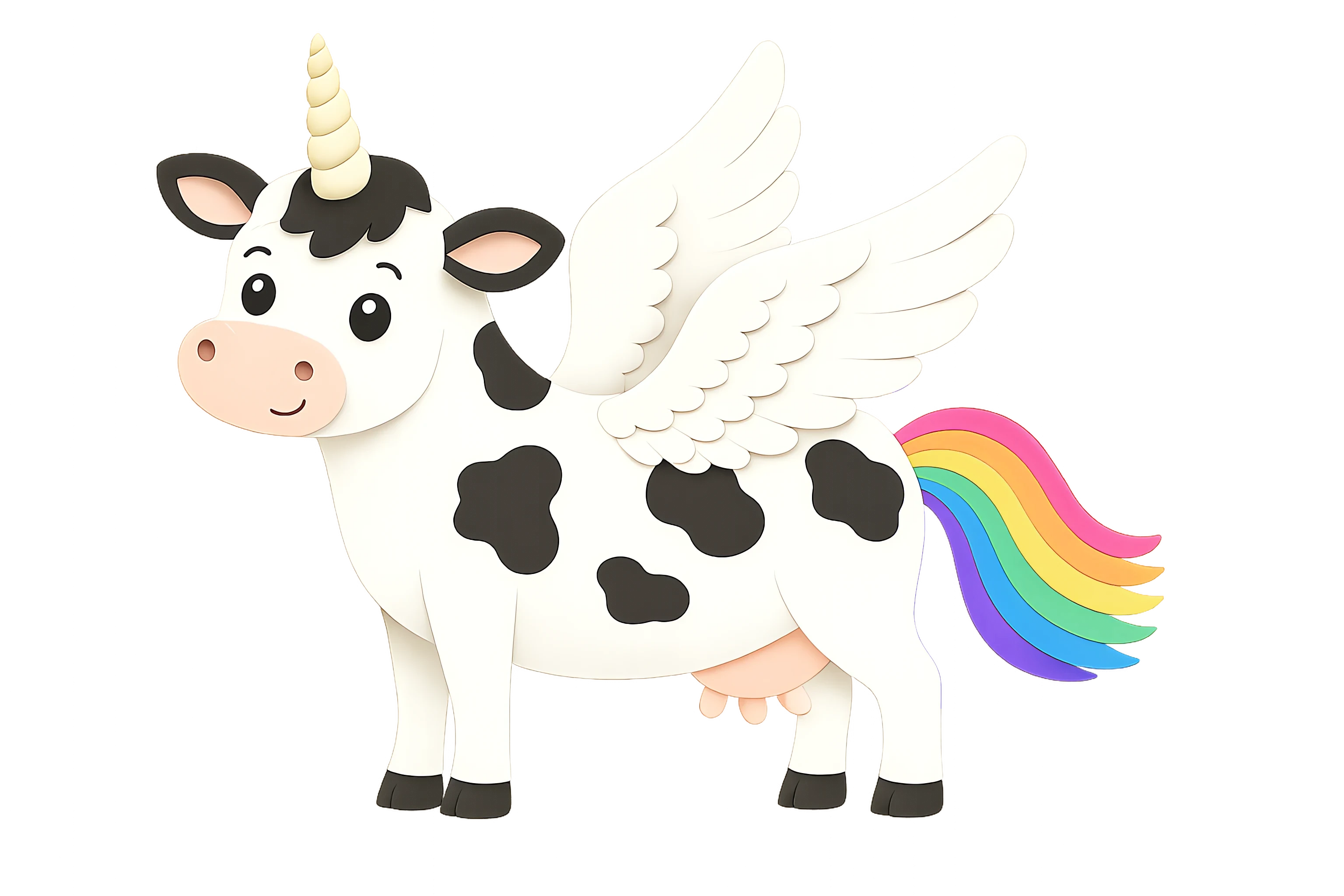
The Horn
Cornu glitterus singularis
Exactly one. Spiraled. Cream-ivory — not rainbow, we get that a lot.
Never, ever cow horns. When Pegacow wears a hat, the horn tucks politely underneath and stays out of sight.
Horn count: 1. Always 1.
Exhibit B · Exterior
The Ears
Auricula cookie-dunkus
Black on the outside, pale pink on the inside, like a cookie dipped halfway in strawberry milk.
Range: excellent. Can hear a snack bag open from three pastures away.
Exhibit C · Exterior
Eyes & Muzzle
Boopus maximus
Big friendly eyes, calibrated for maximum “aww.”
Pale-pink muzzle: the official, regulation-size boop target. Boop responsibly.
Exhibit D · Exterior
The Wings
Alae fluffissimae
Two large white feathered pegasus wings. You can only see one from here — the other is on the far side, being shy.
Top speed: classified. Top cuteness while flapping: also classified.
Exhibit E · Exterior
Coat & Spots
Pelagus polka-dottii
Bright white — never gray, never tan — with a few soft black spots.
No two Pegacows share a spot map, and the odd cowlick tuft is a personal choice. What every Pegacow skips: a mane. It has opinions about manes.
Mane count: 0. Sass count: high.
Exhibit F · Exterior
The Udder
Milkshakus fraisus
Small, pale pink, unmistakably cow.
Rumored to dispense strawberry milk exclusively. Unverified. We choose to believe.
Exhibit G · Exterior
Legs & Hooves
Quadrupedus strictus
Count along: one, two, three, four. Exactly four legs, four black hooves.
No arms. No hands. When Pegacow holds a latte, it balances in the tip of one raised front hoof — three on the ground, never a sneaky fifth leg.
Limb audit: passed. ✔
Exhibit H · Exterior
The Tail
Cauda arcus-caeli
Flowing, horse-like, and rainbow-striped from root to tip.
This is the ONLY rainbow part of a Pegacow. Not the horn. Not the udder. We checked. Twice.
Switching to X-ray
Now for the Inside
Everything so far is official, by-the-book Pegacow.
Everything from here on is… also official. Magically official. Please do not ask a veterinarian.
Organ 1 · Head
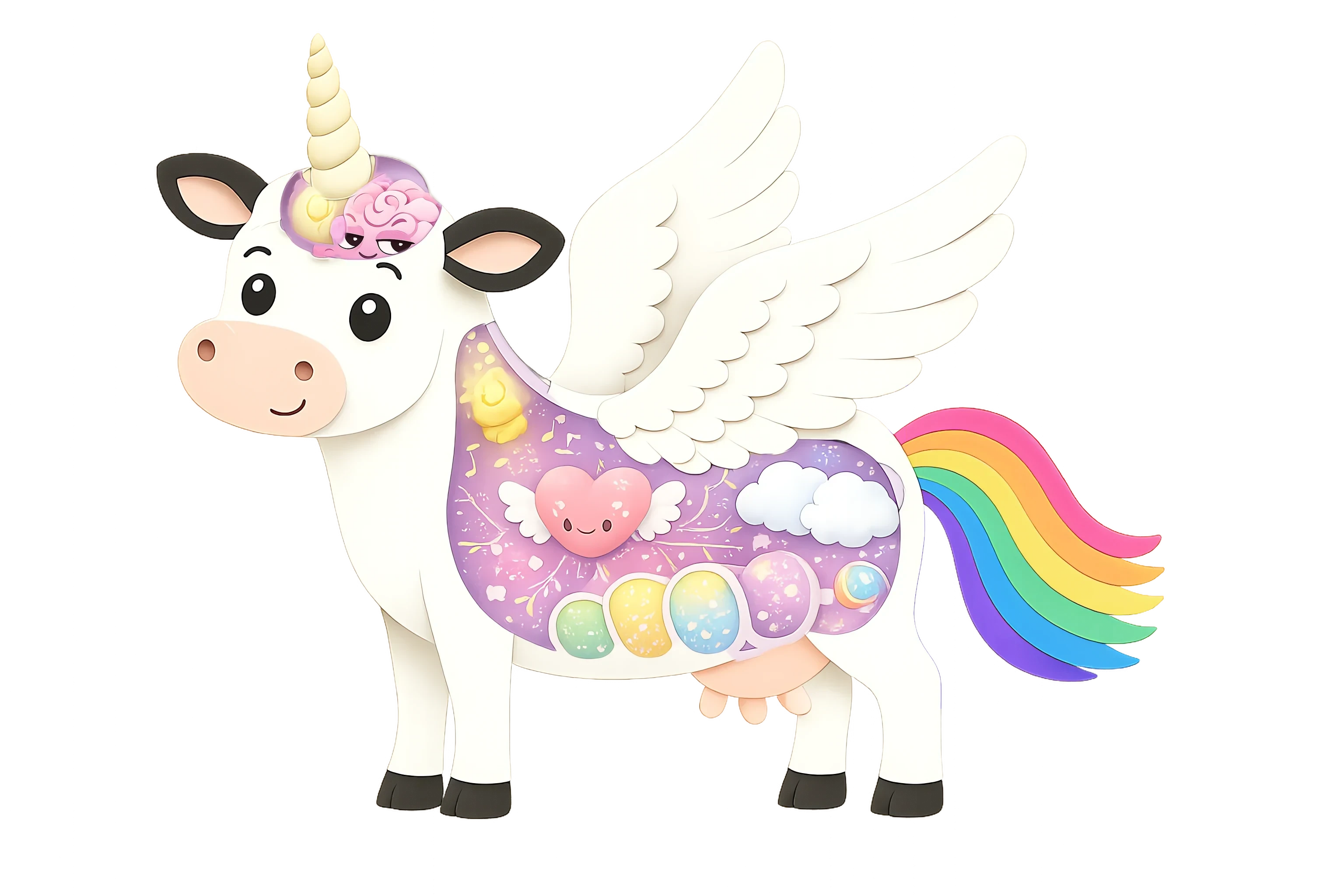
The Mischief Lobe
Cerebrum shenaniganus
Controls plotting, giggling, and the sudden urge to nudge things off tables.
Roughly 80% of capacity is reserved for snack-related schemes.
Organ 2 · Head
The Horn Battery
Accumulator cornicus
Wired straight up to the horn. Recharges overnight on moonlight.
Powers the horn's sparkle, which is the horn's only job, and it does it beautifully.
Organ 3 · Throat
The Moo-sic Box
Larynx melodiosa
Where the moo comes from. Factory-tuned to a cheerful B-flat.
Hum near Pegacow's chin and it hums back a tiny lullaby.
Organ 4 · Chest
The Flutter Heart
Cor volans
A heart with little wings of its own. Every beat sends sparkle up to the big wings.
This is why Pegacow flies faster when it's happy. Science.
Organ 5 · Chest
The Cloud Lungs
Pulmo cumulus
Two fluffy cumulus clouds. In goes clear blue sky; out comes a faint rainbow puff on cold mornings.
Forecast inside Pegacow: 100% chance of fluff.
Organ 6 · Belly
The Four Stomachs
Ventriculi quattuor deliciosi
Real cows have four stomach chambers. So does Pegacow — they just have better names.
Snack, Giggle, Sparkle, and Mystery. Nobody knows what goes into Mystery. Nobody asks.
Organ 7 · Rump
The Rainbow Gland
Glandula iris
Sits at the root of the tail and pumps out fresh color around the clock.
It's why the tail is the only rainbow part: every last drop of rainbow is already spoken for.
Field Guide Complete
Certified Anatomically Wholesome
You now know more about Pegacow than most scientists. (All scientists.)